

Chem21Labs Overview
Perfect Practice Makes Perfect forms the core of Chem21Labs' philosophy. The Practice of Chemistry - or any subject - requires tasks that are carefully assigned, tracked and reviewed to support both improvement and mastery.
"You must inspect what you expect"
Paul J. Meyer – Founder of the Personal Development Industry
At its core, teaching facilitates the progression of a learner from novice to expert. The central question becomes: what are the capabilities of an expert? While expertise encompasses numerous skills, two stand out as particularly critical:
- 1 experts can efficiently provide accurate responses to thousands of questions within their domain in only a few seconds.
- 2 experts are capable of solving complex problems specific to their field with precision, typically following a well-practiced, systematic approach.
The Chem21Labs methodology is designed to emulate these expert abilities by:
- 1 developing fluency in learners.
- 2 introducing opportunities for complex problem solving once sufficient fluency has been established.
Just as a computer's effectiveness depends on its access to databases, so does the brain benefit from interconnected knowledge repositories. A computer with slower processing but broad database connectivity is more valuable than a faster one lacking data. The former delivers answers, albeit slowly, while the latter can, rather quickly, indicate that "the information you seek is not currently available. For learners to master complex problem-solving (Expert Skill 2 ), they must first achieve proficiency in rapid, accurate recall of fundamental concepts (Expert Skill 1 ). Our pedagogical aim is to foster conditions conducive to advanced thinking by connecting learners to extensive databases and enhancing their retrieval speed through frequent practice. To this end, Chem21Labs provides a diverse array of learning tools, enabling students to build comprehensive, connected bodies of knowledge. These resources bolster competence in accordance with the steps outlined by Benjamin Bloom (1956) - steps essential for attaining fluency and accomplishing intricate tasks within any discipline.
- 1 Knowledge
- 1 Comprehension
- 1/2 Application
- 2 Analysis
- 2 Synthesis
- Evaluation
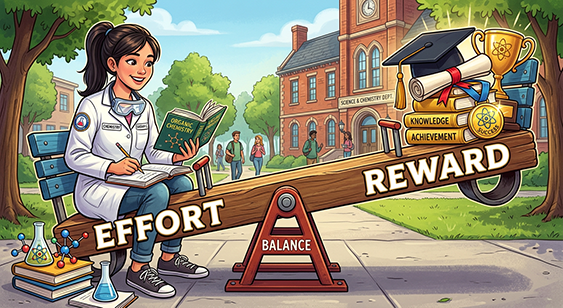
An idea students struggle to accept.
Lower-Order Thinking Skills (LOTS)
Timed / Repetitive Quizzes (TRQs) help students build knowledge, comprehension, and application of chemical facts and processes. Chemistry involves LOTS of information, and TRQs transform textbook facts into an engaging, active-learning assignment that is both low-pressure and highly rewarding. Each TRQ question must be designed so that an expert (the teacher) can answer it in 6 seconds or less, ensuring the content remains at the most accessible cognitive level. This approach allows novices to quickly develop expert-like fluency. Over time, students learn that their effort directly impacts their results - using effective study strategies leads to the best long-term outcomes.
You may have noticed that while most students submit assignments by their due dates, far fewer complete suggestions by the "suggested date". For example, guidance such as "memorize this list of cations and anions by the next class period so we can use this information to write formulas for ionic compounds" often goes unheeded. By transforming such suggestions into actual assignments, accountability and engagement are greatly improved.
As a practical application, please take the Cation / Anion quiz (be sure to open the Instructions Panel for detailed information on how to proceed). Challenge yourself to achieve a perfect score - 10 out of 10 correct - and complete the quiz to solidify your understanding of a Timed / Repetitive Quiz.
Chem21Labs has created over 4000 general chemistry (5000 organic chemistry) Multiple-Choice and Fill-In-The-Blanks TRQ questions.
Before TRQs were introduced, experienced teachers would often emphasize the importance of their recommendations by linking them to an upcoming assessment: "there will be a quiz over this list of cations and anions at the start of the next class."
This strategy was employed to motivate students to study the material in advance. However, its effectiveness largely depended on each student's study habits and how much the quiz influenced their overall grade.
When instructors assign class quizzes, they devote significant time and energy to designing and grading each quiz. Student preparation ranges from:
- cramming the night before or the morning of the quiz
- ignoring the quiz if it has minmal impact on their grade
- applying a spaced-retrieval approach over several days for deeper learning
While the quiz does inspect what you expect, the time it consumes and less-than-ideal class performance led us to believe there is a better way. Fortunately, there is . . . .
TRQs (aka Targeted Retrieval Quizzes) streamline and improve the learning of foundational knowledge for the novice. TRQs encourage consistent and active engagement with the content through repeated practice, which helps prevent last-minute cramming. They also lighten the instructor's workload by automating grading and feedback, freeing up time for actual teaching rather than administrative duties.
TRQ assignments transform poor study habits by implementing a reliable spaced-retrieval method. TRQs give instant feedback, are automatically graded and recorded, are completed outside of class, and over 90% of students finish them because they are . . . .
- Low Stakes - every student can succeed if they put in the effort, as there are multiple ways to earn full credit and everyone can meet the requirement of answering a certain number of questions correctly.
- High Reward - students receive course credit for their studying.
Click More TRQ Info for details about the theory, application and research results.
Higher-Order Thinking Skills (HOTS)
The Chem21 curriculum actively engages the Application, Analysis, and Synthesis levels of cognitive thought through a variety of interactive assignments. These assignments encourage students to apply concepts, analyze data, and synthesize new ideas within the context of chemistry.
Interactive TRQs (iTRQs)
iTRQs are low-stakes assignments that present HOTS content in a timed environment where the time is significantly longer than the time allotted for TRQs.
- Limiting Reagents (Open Limiting Reagent Animation)
- Activity Series (Open Activity Series Animation)
- Organic Mechanisms (Open Organic Mechanisms Animation) - complete a 1-step or 2-step mechanism before the timer reaches 0.0 seconds . . . . the timer is located on the webpage of the actual assignment and not in the demo.
- Mouseover the oxygen's (water) lone electron pair.
- Click / drag the mechanism arrow to the Hydrogen atom in H–Cl
- Mouseup
- Mouseover the H–Cl bond.
- Click / drag the mechanism arrow to the Chlorine atom
- Mouseup
- ✓ Mechanism Complete
Tutorials
Tutorials are designed to be low-pressure, flexible learning experiences that advance a student's Higer Order Thinking Skill (HOTS). They feature interactive animations that guide students through the material needed to complete assignments and earn full credit. In this "safe learning environment," any mistakes are explained before students try again - there are no penalties for restarting. Instead, students earn points by successfully finishing the tutorial, encouraging learning and mastery without fear of losing points.
Besides the Thin Layer Chromatography tutorial below, other Chem21 Tutorials are available:
- Open Phase Diagram And Heating Curve Tutorial
- Open Solution Concentration Tutorial
- Open Reading A Buret Tutorial
- Open Assigning Stereochemistry Tutorial
- Open Reading A Refractometer Tutorial
Begin the Thin Layer Chromatography lab tutorial by selecting the pencil icon. Observe how samples are spotted, compounds are separated, and their final positions are visualized. Once the tutorial concludes, determine the Rf values for each sample and identify the compounds in your virtual unknown.
Learning Pathways
Students develop Higher Order Thinking Skills by tackling complex questions. Learning pathways reinforce these skills and processes by requiring students to use them when submitting their responses.
During the initial weeks of chemistry, students learn "short" dimensional analysis pathways like . . . .
- Metric ⇆ Metric conversions between
- Length
- Mass
- Volume
- Cubic Length ⇆ Volume Conversions
- Mass ⇆ Volume (using Density)
- Mass ⇆ Moles (using Molar Mass)
- Moles ⇆ Atoms (using Avogadro's Number)
- Moles ⇆ Liters (using Molarity)
- Moles ⇆ Moles (using Chemical Equation Coefficients)
After four to five weeks, students are expected to synthesize a complex pathway from these "short" pathways to solve questions such as:
3.45 m3 of hydrogen gas reacts with excess oxygen. Calculate the volume of water produced, expressed in kiloliters (kL).
Where appropriate, Chem21Labs has developed learning pathways designed to construct a "big picture" that assists students in achieving learning objectives. As students engage with these pathways, they integrate correct complex thinking routes into their cognitive schema.
Dimensional Analysis Map I covers the basics of dimensional analysis.
- Length
- Area
- Mass
- Volume
To convert 4.5 miles to femtometers (fm), start by clicking the "Miles" option in the Length section. Next, select Foot, Inch, cm, Meter, and finally fm. Observe how the units are displayed in the center section - each is positioned so that they cancel out until only femtometers remain. During a real Chem21 assignment, when students click the Next button, they are directed to a webpage where they input conversion factors and unit labels (i.e. 18.015 g H2O), resulting in an answer formatted just like worked solutions found in textbooks. After submission, Chem21 evaluates each part of the answer and identifies any mistakes. This hands-on approach, combined with immediate, targeted feedback, creates effective learning.
Dimensional Analysis Map II extends the dimensional analysis pathways by . . . .
- connecting Cubic Length to Volume (1cm3 = 1mL)
- connecting Mass to Volume (density)
- connecting Mass to Moles (molar mass)
- connecting Moles to Molecules (Avogadro's number - 6.022E23)
To convert 0.5 L water to moles, start by clicking the "Liter" option in the Volume section. Next, select mL, Gram (read the alert info and press OK), and Mole. The units appear at the bottom and are arranged to cancel out, leaving only Moles. Clicking Next opens a webpage to enter the rest of the problem, which Chem21 then checks for errors and immediately displays targeted feedback for enhanced learning.
The Two Units button solves for quantities like density, molar mass, and molarity. Click Two Units to view the updated dimensional analysis setup.
Dimensional Analysis Map III
- Element → Element conversion (molar ratio from a compound's formula)
- Compound → Compound conversion (molar ratio from a balanced equation)
- Moles → Liters of Solution (Molarity)
Using the "Big Picture" of Map 3, students can easily answer the question that was posed above . . . .
3.45 m3 of hydrogen gas reacts with excess oxygen. Calculate the volume (kL) of water produced.
Empirical Formula Calculator - students use this calculator to verify their answers at every stage while establishig a compound's empirical formula. Additionally, it assists in finding molecular formulas.
Use the calculator to find the empirical and molecular formula for chrysotile asbestos. Its percent composition is 28.03% Mg, 21.60% Si, 1.16% H, and 49.21% O, with a molar mass of 520.8 g/mol.
- Click the "4" elements radio button
- Click the % button
- Click the Checkbox at the top of the calculator to allow TAB and ENTER key navigation.
- Enter Mg in the first box, TAB and enter Si, H and O in the remaining boxes.
- Click the Enter key
- Enter the percents and click the Enter key
- Continue the actions above until you have determined the empirical and molecular formula for chrysotile asbestos.
pH Calculator - an interactive "guide" that provides choices to lead students through thirty types of pH problems and their corresponding calculations. At every stage, calculations are verified and prompt feedback is supplied. The solution's pH, pOH, [H3O+] and [OH-] are calculated as the final step.
Use the calculator to find the pH of a 0.250 M HCl solution.
- Click the "SA" radio button since HCl is a strong acid
- Click Continue button
- Select HCl from the dropdown list
- Enter 0.250 as the Molarity.
- Click Continue button
- Complete the chemical equation
- Click Check button
- Enter values in the ICE table by clicking the Edit button next to the text box to make it "active"
- Click Check button
- Enter the pH
- Click Check button
- Enter the [OH–] and pOH
- Click Check button
Homework
Chem21Labs offers a comprehensive homework curriculum with numeric, chemical equation, nuclear equation, multiple choice, text, and multiple select problems. Additionally, the dimensional analysis methods outlined above are incorporated into homework assignments, complemented by targeted exercises focused on drawing Lewis structures, organic molecules, curved-arrow mechanisms and synthetic pathways in organic chemistry.
LewisDraw - students use a drawing canvas to write Lewis structures. You can draw a Lewis structure in the app below, but to experience the grading component click the Lewis Structure lab.
Draw the Lewis structure of water, H
••
– O –
••
H
- Click the "Auto 3D" radio button
- Click the Oxygen symbol
- Click on the drawing canvas
- Click on the Hydrogen symbol
- Click the Oxygen atom on the drawing canvas and drag to create a bond to Hydrogen. Mouseup to place the Hydrogen on the canvas
- Repeat for the second Hydrogen
- Click the electron pair icon
- Click the Oxygen atom twice to add two lone electron pairs
- Click on the molecule and drag to rotate
Chem21Draw - provides a portal for the submission of organic structures, mechanisms and synthetic routes as answers to homework problems. You can draw an organic molecuel in the app below, but to experience the grading component click a Chem21Draw assignment.
Click on the Benzene ring and then click on the white drawing canvas.
Click on two adjacent carbon atoms of the benzene ring to form o-xylene (1,2-dimethylbenzene).
Lab Reports
Chem21Labs grades lab calculations, equations, and graphs instantly as students enter them. Two key benefits are immediate feedback, which enhances learning - especially when delivered promptly and multiple attempts to enter a correct answer.
Introducing feedback into any process increases learning . . . .
the more immediate the feedback, the greater the effect.
The program grades all results except images and essay answers. If lab results are evaluated, Chem21Labs generates custom web reports that display lab results and apply the instructor's grading rubric.
University Labs - coordinators create a lab report design in Excel for the labs they are currently using. Then, Chem21Labs specialists convert the Excel design into interactive webpages (2-6 hours). Each lab costs $1.20 per student . . . . ten labs total $12 for a semester.
Virtual Labs - HTML5-JS lab animations are assigned as pre-lab assignments or virtual labs for distance learning courses. These virtual labs are embedded in the interactive lab report webpage and contain all the features described above. The web page and the animation can "communicate" so that unknown information and randomized data flows from the Chem21Labs program to the animation and data collected in the animation can flow onto the web page. Visit our Demo Lab webpage to view our virtual labs and to work through them as a student.
Hybrid Labs - combine a virtual lab with a hands-on lab experiment that is performed in the student's kitchen where heating is provided by microwave or oven. The Chem21 goal is to provide a quality hands-on lab experience with the following equipment and instrumentation . . . .
| . . . generally regarded as safe. chemicals | milligram balance | digital thermometer | AC/DC converter |
| 100 mL Pyrex beaker | 50 mL graduated cylinder | test tubes | Styrofoam calorimeter |
The kitchen-based lab experience is enhanced with virtual labs that contain:
virtual lab equipment
| ring stand / clamp | wire gauze | Bunsen burner | graduated cylinder |
| evaporating dish | watch glass | crucible and lid | pipettes |
| test tubes | beakers | Erlenmeyer flasks | stirring hot plate |
| cathode ray tube | chromatography chamber | buret | bomb calorimeter |
virtual instruments
| balance | temperature gauge | pressure gauge | pH meter |
| spectroscope | spectrometer |
The hybrid lab approach reduces cost, ensures safe experimentation
without expert supervision, and delivers a quality learning experience.
Integrating computer-based exercises at the lowest cognitive levels requires a shift in teaching approach where the instructor gives herself permission to assign an online workload that requires the student to engage in active learning activities for part of the "expected" hours of study. If 10 hours per week is "expected" for proficiency in an Organic Chemistry course, low cognitive load exercises (TRQs, iTRQs, Tutorials) should be assigned that require a focused and engaged learner to spend ~ 3 hours completing the assignments, with the rest spent on reading (1 hour), homework (~ 5 hours) and preparing for exams (1 hour).
The interactive, guided assignments listed above have been used at the university level for twenty years - the results for the first twelve years (same instructor) are outstanding. At Lee University (Cleveland, TN), the ACS Organic Chemistry Exam is given each year as the Final Exam.
- The average class percentile on this exam over those twelve years (2006-2017) was 59.4 percentile . In the 15 prior years (1991-2005), the class averaged was 41.1 percentile .
- From 2006-2017, only 3 students dropped the second semester course during . . . 386 / 389 students who started the class in January sat for the ACS Exam in late April. From 1991-2005, 15% of students (37/248) in the 2nd semester course withdrew and did not take the ACS Final Exam.
- 13 students scored above the 90th percentile (1991-2005) . . . . 46 students scored above the 90th percentile (2006-2017)
For more information on the efficacy of TRQs in various subjects, click TRQ Research.